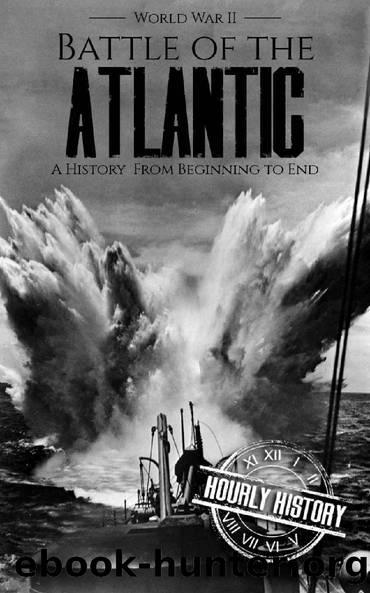
Battle of the Atlantic - World War II: A History from Beginning to End (World War 2 Battles Book 11) by Hourly History
Author:Hourly History [History, Hourly]
Language: eng
Format: epub
Published: 2019-07-15T00:00:00+00:00
Chapter Four
The High Point of the U-boats
âIt appeared possible that we should not be able to regard convoy as an effective system of defence.â
âRoyal Navy Report
Admiral Dönitz did not waste any time in sending his U-boats to the Atlantic coast of the United States after the Americans entered the war in December 1941. Events had taken place with such rapidity that the United States was suddenly cast from its neutrality into the heart of the war. In the midst of the confusion that followed its entry into the war, the United States Navy neglected to act upon intelligence obtained by the British that Admiral Dönitz planned to launch Operation Drumbeat to send a significant contingent of his U-boats to the eastern shores of the United States.
It must have seemed like easy pickings for the U-boats. The Americans didnât set blackouts along the eastern coast, nor did the United States form convoys along the shore. By the end of January 1942, 53 U-boats had sent 100 Allied ships to the bottom of the Atlantic, and most of those ships were attacked off the East Coast of America. For the Germans, this was the U-boatâs second âhappy timeâ as they exploited the vulnerability of the unescorted American merchant ships.
Realizing the need to provide defense for their merchant ships, the U.S. put a convoy system in place in 1942, and in response, the U-boats withdrew to the mid-Atlantic that summer. Both sides experienced heavy losses in the battles waged between the escorts and the U-boats. Admiral Max Horton became commander-in-chief of the Western Approaches Command in November 1942, and he added to the convoy escorts as more vessels became available. These ships, because they were not specifically tied to convoy defense, were able to hunt U-boats.
The year 1943 began with a continuation of the peril upon the Atlantic. Great Britain faced a dire situation with low supply levels because of the mounting Allied shipping losses; the Germans were sinking ships faster than the Allies could build new ones. Determined to deal a death blow to the supply lifeline keeping the Allies in the war, Dönitz sent all of his U-boats into the Atlantic. The convoys were daunted by the threat of the U-boat attacks. Churchill made the decision to cancel the next planned outgoing and returning convoys. Roosevelt disagreed with Churchillâs decision; the convoys, he said, needed to sail whenever possible.
The German Kriegsmarineâs wolf pack tactics made the U-boats a deadly force in the Atlantic as they set simultaneous surface attacks at night, a time which was much more effective for them because, during the day, the patrolling Allied aircraft overhead limited their ability to converge on the convoys. The winter season provided extended periods of darkness in the North Atlantic, concealing the submarine operations as they surfaced. The winter of 1942-1943 saw the greatest number of submarines sent to the mid-Atlantic, this at a time when comprehensive anti-submarine aircraft were not yet patrolling that part of the ocean.
March 1943 was the height
Download
This site does not store any files on its server. We only index and link to content provided by other sites. Please contact the content providers to delete copyright contents if any and email us, we'll remove relevant links or contents immediately.
| Africa | Americas |
| Arctic & Antarctica | Asia |
| Australia & Oceania | Europe |
| Middle East | Russia |
| United States | World |
| Ancient Civilizations | Military |
| Historical Study & Educational Resources |
The Dawn of Everything by David Graeber & David Wengrow(1707)
The Bomber Mafia by Malcolm Gladwell(1622)
Facing the Mountain by Daniel James Brown(1553)
Submerged Prehistory by Benjamin Jonathan; & Clive Bonsall & Catriona Pickard & Anders Fischer(1455)
Wandering in Strange Lands by Morgan Jerkins(1430)
Tip Top by Bill James(1416)
Driving While Brown: Sheriff Joe Arpaio Versus the Latino Resistance by Terry Greene Sterling & Jude Joffe-Block(1376)
Red Roulette : An Insider's Story of Wealth, Power, Corruption, and Vengeance in Today's China (9781982156176) by Shum Desmond(1359)
Evil Geniuses: The Unmaking of America: A Recent History by Kurt Andersen(1353)
The Way of Fire and Ice: The Living Tradition of Norse Paganism by Ryan Smith(1336)
American Kompromat by Craig Unger(1315)
F*cking History by The Captain(1304)
It Was All a Lie by Stuart Stevens;(1300)
American Dreams by Unknown(1286)
Treasure Islands: Tax Havens and the Men who Stole the World by Nicholas Shaxson(1273)
Evil Geniuses by Kurt Andersen(1257)
White House Inc. by Dan Alexander(1212)
The First Conspiracy by Brad Meltzer & Josh Mensch(1174)
The Fifteen Biggest Lies about the Economy: And Everything Else the Right Doesn't Want You to Know about Taxes, Jobs, and Corporate America by Joshua Holland(1126)
